 University of North Texas

Lab research falls under three main topics: insect biodiversity under global change, insect foraging, and ecosystem services. This and this articles give a brief overview.
Current projects include:
- How do grazing practices impact pollinators and the resources that support them? This project is in collaboration with working ranches near UNT, including The Dixon Water Foundation.
- What other flower visitors do bees use as sources of social information, and does this information use among types of flower visitor?
- How can we better study the economics of crop pollination?
Past projects include:
- Native grassland restoration for pollinators
- Bumble bee nectar robbing decisions
Insect biodiversity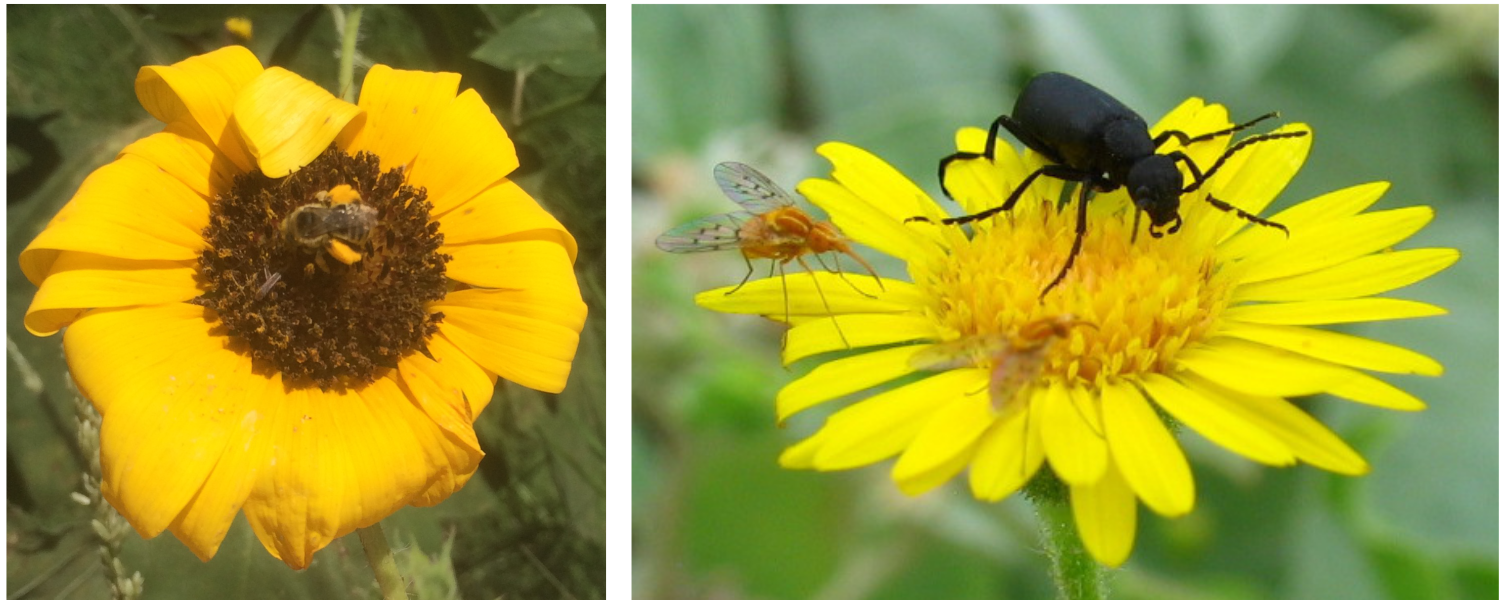
Habitat loss and agricultural intensification degrade biological communities, thereby altering biodiversity, interactions within those communities, and ecosystem services and functions. Land management practices such as diversified farming and grassland restoration, on the other hand, seek to restore highly functional communities. We are interested in how both habitat loss and land management alter communities of flower-visiting insects.
- One current line of research investigates impacts of ranch management on plant and pollinator biodiversity, and plant-pollinator interactions. This includes how species' traits mediate responses to habitat change and shape interactions.
- We also work with state and federal agencies, non-profits, and other bee researchers to improve knowledge of bee species' conservation status. We are currently developing a workflow to gather, clean, and standardize large numbers of species occurrence records, and developing a checklist of Texas native bees (~1300 species!).
- We are involved in several international collaborations that aim to integrate insect traits databases and develop standards for measuring such traits.
Representative publications:
- Publications with Shannon Collins, Avery Pearson, or Hunter Messick as first author
- Cardoso P, Baker NJ, Boieiro M, Bonte D, Borges PAV, Braby M, Branco V, Carvalheiro L, Chobanov D, Correia L, Dalton D, Damas-Mora M, Didham RK, Forster L, Glatz R, Gorneau JA, Hochkirch A, Kirse A, Lichtenberg EM, Macías-Hernández N, Miličić M, Moir M, Moreno-García P, Neessen R, Noriega JA, Penick CA, Perry KI, Pryke J, Rego C, Roeder KA, Saussure S, Shirey V, Sihvonen P, Svetnik I, Tarasov S, Welti EAR, Wong M, Scherber C. 2026. Towards a global repository of insect traits (GRIT). Insect Conservation and Diversity 19: 253-267.
Insect foraging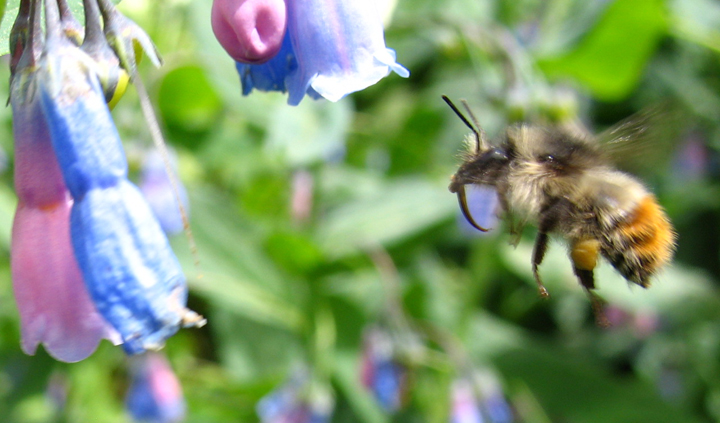
Deciding what, where and how to feed provides many challenges in complex natural environments. Active foragers, including many pollinators and predatory insects, locate and determine the identity of the most profitable food types using information from the environment. For example, bees can learn about flowers by attempting to feed from them, but also by observing other bees foraging. Our research in this area currently focuses on bees. It attempts to determine what bees use as information when feeding, how they respond to different types of information, how such foraging decisions affect pollination, and how human activities alter bee foraging.
Representative publications:
- Muñiz M, Meadows BT, Lopez P, Lichtenberg EM. Social information use across trophic guilds: foraging bumble bees learn from lady beetles. Behavioral Ecology 37: arag019.
Economics of pollination
Current methods for studying the economics of crop pollination demonstrate the importance of this ecosystem service. However, these methods lack sound conceptual ecological and economic basis and are not sufficiently robust to support decision-making by farmers and policy makers. They also can be applied only to crops and regions for which intensive on-the-ground data collection has occurred. In collaboration with economists and computer scientists, we are developing new methods and tools to better value pollination and other insect-provided ecosystem services.
Representative publications:
- Yuan X, Chakravarty A, Lichtenberg EM, Gu L, Wei Z, Chen T, Zhang R. 2026. An empirical analysis of deep learning methods for small object detection from satellite imagery. Expert Systems with Applications 307: 131061.
- Baylis K, Lichtenberg EM, Lichtenberg E. 2021. Economics of pollination. Annual Review of Resource Economics 13: 335-354.